


Trough-type Stainless Steel 304/316 Cable Tray
304/316 Stainless Steel Cable Trays: Definition, Characteristics and Applications
Basic Definition
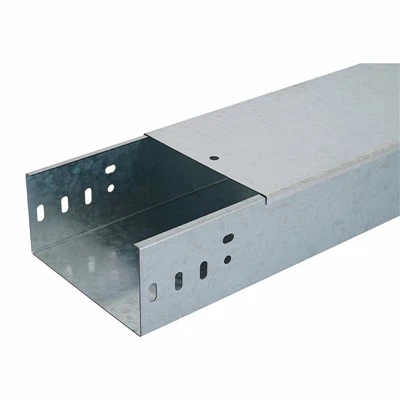
The trough-type stainless steel 304/316 cable tray is a fully enclosed cable laying device made of stainless steel (304 or 316 grade). It is mainly used for supporting, protecting, and neatly laying power and communication cables. Its structure is a fully enclosed design of "trough body + cover plate", which can effectively protect cables from the influence of the external environment (such as dust, moisture, mechanical damage), and is widely used in scenarios with high requirements for corrosion resistance and safety.

Core Materials: 304 Stainless Steel vs. 316 Stainless Steel
Stainless steel is the core characteristic of this cable tray. 304 and 316 are two commonly used grades, with the main differences stemming from their composition and corrosion resistance.
|
Parameter |
304 stainless steel |
316 stainless steel |
|
Main ingredients |
Chromium (Cr) 18% + Nickel (Ni) 8%, Mo (Mo) excluded |
Chromium (Cr) 16% + Nickel (Ni) 10% + Molybdenum (Mo) 2-3% |
|
Corrosion resistance |
It has good resistance to general corrosion and can withstand air, water, and weak acid and alkaline environments (such as dry/humid indoor environments). |
The addition of molybdenum (Mo) significantly improves its resistance to pitting and crevice corrosion, especially its resistance to chloride ion (Cl⁻) corrosion (such as in seawater and chemical waste environments). |
|
Applicable Scenarios |
Suitable for indoor dry/humid environments (office buildings, shopping malls, ordinary factories) and non-corrosive environments. |
Highly corrosive environments (coastal areas, chemical plants, wastewater treatment plants, food processing plants, offshore platforms), and high humidity/high salt spray scenarios. |
|
Cost |
Relatively low price, high cost performance |
The cost is higher than that of 304 (molybdenum increases the cost of raw materials), but the lifespan is longer and the overall maintenance cost is lower. |
Structural Features
- Fully enclosed design : The tank has a U-shaped groove structure and comes with a cover plate (removable). It has a high protection level and is dustproof, waterproof (IP40 and above, depending on the sealing accessories), and resistant to mechanical impact, preventing exposed cables from being damaged.
- Modular components : Composed of a channel body, cover plate, bracket (column/arm), and connectors (such as elbows, tees, reducers), supporting customized lengths (standard 1-3 meters/section) and on-site splicing, adaptable to complex laying paths.
- Load-bearing capacity : The stainless steel material has high strength (tensile strength ≥520MPa), and the thickness of the tank (usually 1.0-2.5mm, selected according to load-bearing requirements) determines the load-bearing capacity. The standard specifications can bear 50-200kg/m (uniform load).

Core Advantages
- Ultra-long lifespan : Stainless steel is naturally rust-resistant. 304 has a lifespan of 15-20 years, and 316 has a lifespan of over 25 years in highly corrosive environments, far exceeding carbon steel cable trays (which require regular anti-corrosion treatment and have a lifespan of 3-8 years).
- Low maintenance costs : No need to apply anti-rust paint or galvanize; daily cleaning of surface dust is all that is required, reducing maintenance workload.
- Aesthetics : Stainless steel has a smooth surface (mirror/brushed finishes are available), making it suitable for places with high requirements for environmental aesthetics (such as cleanrooms and high-end office buildings).
- Safety : Non-metallic materials (such as plastic cable trays) are prone to aging, and carbon steel cable trays are prone to rust and breakage, while stainless steel cable trays are resistant to high temperatures (long-term operating temperature -270~400℃), anti-aging, and do not release toxic gases in the event of a fire.
Typical Application Scenarios
- 304 stainless steel cable trays :
Indoor power distribution systems (office buildings, hospitals, subways), general industrial plants (machinery manufacturing, electronic assembly), and humid but not highly corrosive environments (basements, parking lots).
- 316 stainless steel cable trays :
Highly corrosive environments include coastal areas (high salt spray), chemical workshops (acid and alkali waste gas/liquid), sewage treatment plants (chlorine-containing wastewater), food processing (acid and alkali cleaning environments), offshore wind power platforms, and ship engine rooms.
Specifications and Selection Guidelines
Standard specifications :
Width: 50mm, 100mm, 150mm, 200mm, 300mm (larger sizes are available upon request);
Height: 50mm, 75mm, 100mm, 150mm (the greater the height, the more cables it can accommodate);
Thickness: 1.0mm (light load), 1.5mm (medium load), 2.0mm (heavy load).
Key selection criteria :
- Environmental corrosivity : Prioritize the selection of 304 or 316 based on chloride ion concentration and acid/alkali strength (choose 316 for coastal/chemical environments, and 304 for general environments).
- Cable quantity/weight : Select the tank specifications (width × height) and thickness based on the total cross-sectional area of the cables (not exceeding 40% of the tank cross-sectional area) and the total weight;
- Laying route : Complex routes require accessories such as elbows (90°/45°), tees, and reducers to ensure a smooth transition.

Differences from other cable trays
|
Cable tray type |
Structural features |
Protective |
Applicable Scenarios |
|
Trough-type cable tray |
Fully enclosed (with cover) |
Highest |
High protection requirements (dust/corrosion/waterproof) |
|
Tray-type cable trays |
Semi-enclosed (with holes at the bottom) |
medium |
Indoor scenarios with high requirements for dryness and heat dissipation |
|
Ladder cable tray |
Mesh (without cover) |
lowest |
Large-diameter cables, high-heat dissipation scenarios |
Summarize
Trough-type stainless steel 304/316 cable trays offer high protection and long lifespan cable laying solutions. By offering different material options (304/316), they adapt to a wide range of environments, from ordinary to highly corrosive. Their core value lies in "protection + durability," making them particularly suitable for industrial and commercial applications where safety and maintenance costs are critical. Selection should be based on a comprehensive assessment of environmental corrosivity, cable parameters, and laying path to ensure maximum cost-effectiveness.
Hot Tags: trough-type stainless steel 304/316 cable tray, China trough-type stainless steel 304/316 cable tray manufacturers, suppliers, factory, perforated cable tray types, cable tray wire type, mesh cable tray, cable ladder hot dip galvanized, Anti corrosion aluminum alloy trough bridge, aluminum ladder tray
You Might Also Like



Send Inquiry